



Following the recent debacle, coupled with poor performances, Woodford Patient Capital Trust (LSE: WPCT) shares have lost around 25% in the last three weeks alone.
Unlike Neil Woodford’s Equity Income fund, which was closed to new investments and withdrawals and lost 20% in value in June, his investment trust (Patient Capital) cannot have the same fate.
Closed-end funds are immune to withdrawals
Woodford Patient Capital Trust is a closed-end fund where funds are raised at inception with shares’ issuance as in an IPO. Like a company’s shares, closed-end funds trade on the stock market and Patient Capital is currently trading on the FTSE 350.
The valuation of closed-end funds is tangible and follows the value of their assets while the prices of their share is more volatile. Today, Patient Capital is trading at around 63p to £1, representing a 37% discount on its valuation.
The launch of Woodford’s personal fund in 2015 with great fanfare was a success, and attracted at its peak £15bn of investor money in 2017. The loss of confidence following poor performance and large investors withdrawals led to a decline in the fund’s shares.
Woodford is expected to leave, but what happens next?
Neil Woodford was a star manager at Invesco for 25 years, surpassing benchmark indices and surviving the dot.com bubble and the subprime crash.
Its recent poor performance and the subsequent closure of its equity income fund have forced Patient Capital’s board, in consultation with its broker Winterflood Securities, to consider Woodford’s departure. But what happens when a poor manager leaves a fund?
Depending on new hires and the reorganisation of the management team, Patient Capital – while keeping the same name – can be considered as a brand-new fund.
A revival for Patient Capital shares?
Usually, when star managers leave a fund, a massive withdrawal of investors follows, and the subsequent performance of the fund decreases. Famous examples include the departure of Richard Buxton from Schroders, which caused an exodus of £3.35bn.
But when poor performers leave the fund, the opposite also happens.
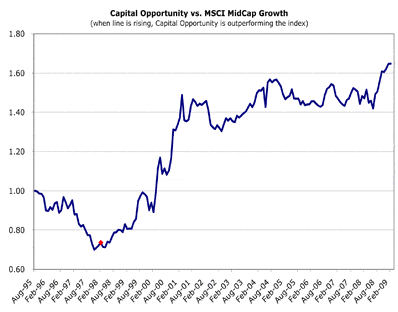
This chart (source: Adviser Investments) shows what happened to Vanguard Capital Opportunity Fund performance following a management change (indicated by the red dot) in 1998. Other empirical studies conducted by researchers at CASS Business School show that UK funds improve their performance after the departure of a poor manager by successfully reorganising the management team.
A good buy?
The current discount on the NAV makes an investment in Patient Capital a bargain, in my opinion. Bargain hunters could start buying at these levels and the planned changes at the head of the fund might make it more attractive to returning institutional investors.
Neil Woodford was a cheap manager because his fees were linked to his performance. On the downside, a new management could change the fee structure and make it fixed, but this could be easily compensated by the recovery in performance.